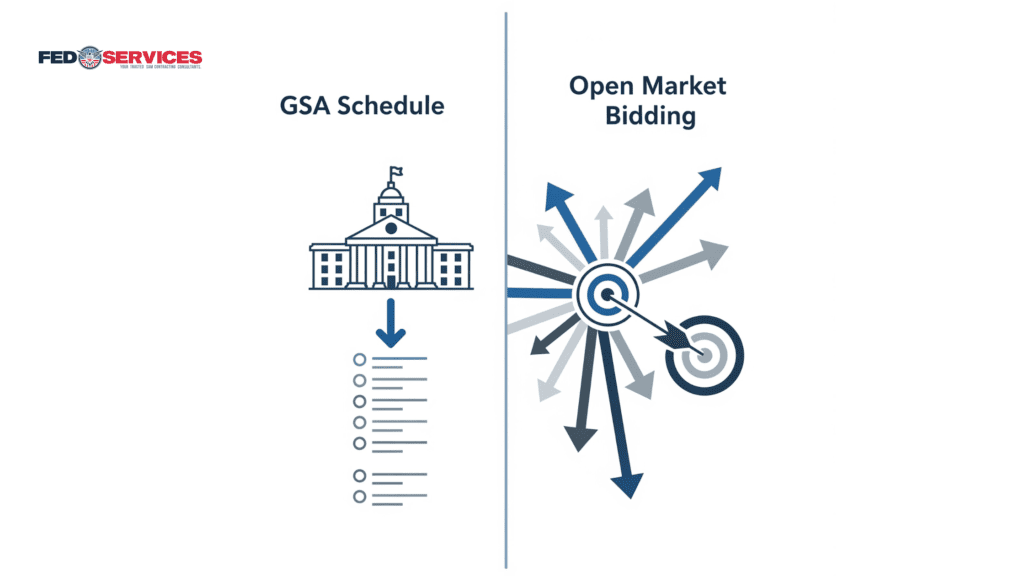
When a small business decides to pursue federal contracts, one of the first major decisions it faces is how to actually access those opportunities. Two primary paths exist: the GSA Multiple Award Schedule and the Open Market Bidding system. Understanding how each one works — and what each one demands from your business — is essential before committing your time and resources.
What is the GSA Schedule?
The GSA Multiple Award Schedule, commonly called the GSA Schedule or MAS, is a long-term government-wide contract between a business and the General Services Administration. Once a company is approved and placed on the Schedule, federal agencies can purchase its products or services directly at pre-negotiated prices — without running a full competitive solicitation for each order.
This is the core appeal of the GSA Schedule. The government has already vetted your company, reviewed your pricing, and verified your compliance. Agencies trust that process, which means individual orders can typically be processed in under 30 days. GSA Schedule contracts are awarded for an initial period of five years, with options to renew for up to 20 years total. In fiscal year 2022, federal spending through GSA Schedule contracts exceeded $42 billion, making it one of the largest and most active procurement vehicles in the country.
However, getting on the Schedule is not simple. Your business generally needs at least two years of financial history, documented past performance, and offerings that fall within one of GSA’s defined product or service categories. The application itself requires pricing data, technical capability documents, and financial disclosures. Approximately 60% of first-time GSA offers are rejected due to documentation issues. Once approved, though, only around 4% of small businesses hold a GSA Schedule — which means the competitive pool is significantly smaller than the open market.
Companies holding a GSA Schedule report an average of $927,000 in annual contract revenue, according to industry data — a figure that reflects the steady, recurring nature of Schedule-based sales.
What is the Open Market Bidding system?
The Open Market Bidding system refers to competitive solicitations posted on SAM.gov that are open to any qualified vendor — not just those with a pre-approved contract vehicle. A federal agency publishes a solicitation describing its requirements, interested vendors submit proposals, and a contracting officer evaluates those proposals based on technical merit, pricing, and past performance before making an award.
Unlike the GSA Schedule, the Open Market Bidding system does not require pre-approval or years of established financial history. If your business is registered in SAM.gov and can respond to a solicitation compellingly, you are eligible to compete. This makes it the natural entry point for newer companies that are still building their federal track record. It is also the primary route for specialized, custom, or one-off government needs that do not fit neatly into the categories the GSA Schedule covers.
The tradeoff is time and competition. Open market procurements can take four to six months per contract from solicitation to award. Each bid requires a fresh proposal, fresh pricing negotiations, and in many cases, extensive documentation. You may be competing against dozens or even hundreds of vendors, and there is no prior vetting that positions you favorably with the contracting officer before the process begins.
Which path makes sense for your business right now?
If your business is new to federal contracting and does not yet have two years of established performance, the Open Market Bidding system is the practical starting point. It gives you access to real opportunities without the lengthy pre-approval process, and every contract you win builds the past performance record you will eventually need to qualify for a GSA Schedule application.
If your business already has federal experience, consistent revenue, and offerings that align with government buying categories, pursuing the GSA Schedule is a serious upgrade. Federal Acquisition Regulation Part 8.4 allows agencies to purchase from GSA Schedule holders without issuing a standard 30-day public solicitation — a structural advantage that reduces both your sales cycle and the size of the competitive field. Over 40% of purchases made through GSA Advantage benefit small, veteran-owned, or disadvantaged businesses, which means the Schedule actively supports the types of businesses it was designed to serve.
Many successful small businesses ultimately use both. They compete through the Open Market Bidding system to stay active, win diverse contracts, and build credibility — while maintaining their GSA Schedule for steady, recurring agency purchases. The two approaches are not mutually exclusive, and the businesses that understand both tend to grow their federal revenue faster than those that commit to only one path.
Not sure which path fits your business?
Fed Services helps small businesses navigate SAM.gov registration, GSA Schedule applications, and every step of the federal contracting process. Book a free call with our team and we’ll map out the right strategy for where you are today.