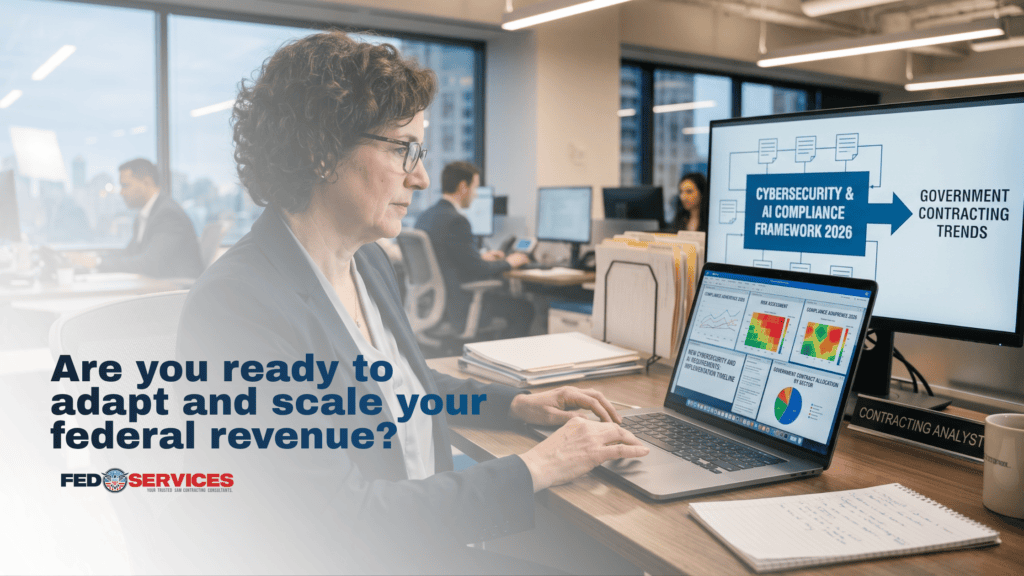
The federal procurement landscape is undergoing a massive transformation. As we navigate the second half of 2026, the traditional rules of engagement are shifting. Agencies are no longer just looking for the lowest bidder; they are aggressively prioritizing supply chain resilience, verifiable cybersecurity, and technological integration.
For small businesses, staying ahead of government contracting trends 2026 is no longer just a strategic advantage—it is a baseline requirement to remain eligible for federal awards. Here are the most critical trends you need to adapt to right now to keep your pipeline full and compliant.
1. Cybersecurity (CMMC) is Now an Eligibility Gate, Not an IT Issue
For years, the Department of Defense (DoD) has warned contractors that stricter cybersecurity regulations were coming. In 2026, those warnings have become a reality with the rollout of the Cybersecurity Maturity Model Certification (CMMC).
Cybersecurity is no longer viewed as just an “IT issue” to be addressed after a contract is won. It is now a strict pre-award condition. If you do not have a documented and verifiable cybersecurity posture, you cannot win DoD contracts—and civilian agencies are rapidly adopting the same standards.
How to Adapt:
Stop relying on self-attestation alone: Solicitations are increasingly requiring documented proof of compliance, such as NIST SP 800-171 gap assessments.
Update your proposals: Make cybersecurity a core part of your capability narrative. Clearly state how you store data, control access, and mitigate third-party risks. The vendor who can confidently answer security questions moves to the top of the “responsive vendor” list immediately.
2. Heightened Scrutiny on “Responsibility Determinations”
Another major shift among government contracting trends 2026 is the intensified scrutiny placed on “Responsibility Determinations.” Before awarding a contract, a contracting officer must determine if a business is “responsible”—meaning they have the ethics, financial viability, and past performance required to execute the job.
Historically, this was a relatively routine check. Today, contracting officers are digging deeper. Agencies are using AI and automated tools to review external compliance issues, labor practices, and CPARS (Contractor Performance Assessment Reporting System) trends.
How to Adapt:
Audit your public profile: Ensure your SAM.gov registration, DSBS profile, and online presence are perfectly aligned and free of discrepancies.
Address past issues proactively: If your business had a minor compliance hiccup in the past, do not hope the contracting officer misses it. Address it directly in your proposal discussions, showing what internal controls you have implemented to fix it.
3. The Integration of AI and Efficiency-Driven Solutions
Federal agencies are facing significant budget constraints and workforce shortages in 2026. As a result, the government is prioritizing contractors who can deliver measurable efficiency gains.
While AI was once a buzzword, it is now a practical requirement in many solicitations. However, agencies are not just looking for AI integration; they are demanding responsible AI with strong data governance, transparency, and bias mitigation.
How to Adapt:
Focus on mission outcomes: When writing proposals, do not just list the features of your service. Explicitly state how your use of technology or automated processes will save the agency time, reduce costs, and improve citizen experiences.
Leverage AI internally: Use tools like FedServices’ AI-Powered Intelligence Platform to automate your opportunity tracking, analyze 10 years of competitor data, and generate win-probability scores. By making your own business development process more efficient, you free up resources to focus on service delivery.
4. Evolving SBA Certification Scrutiny
The Small Business Administration (SBA) set-aside programs remain one of the most lucrative avenues for small businesses to win federal work. However, the legal landscape surrounding programs like the 8(a) Business Development Program has shifted significantly in 2026.
With new guidance reshaping how “social disadvantage” is determined and evaluated, boilerplate applications and outdated corporate profiles are becoming massive liabilities.
How to Adapt:
Treat your certifications like an operating system update: You cannot “set it and forget it.” You must continuously ensure your ownership documentation, financial statements, and corporate narratives align with the latest SBA guidelines.
Seek expert guidance: If you are applying for or renewing an 8(a), WOSB, SDVOSB, or HUBZone certification this year, working with a compliance specialist is critical to avoid costly rejections.
Turn Compliance into a Competitive Advantage
The defining characteristic of the government contracting trends 2026 is that the playing field is changing rapidly. Businesses that rely on outdated strategies, boilerplate proposals, and “good enough” compliance will struggle to win awards.
Conversely, disciplined, low-friction vendors who proactively update their cybersecurity, master their compliance, and leverage market intelligence will turn this wave of change into a massive competitive advantage.
Are you ready to adapt and scale your federal revenue? FedServices is here to guide you through the complexities of 2026 contracting. From compliance-ready SAM registrations to state-of-the-art market intelligence tools, we provide everything you need to win. Call us today at (833) 454-7268 to future-proof your GovCon strategy!